
Choose the room, not the flyer. A networking event is worth your evening when the people you want to meet, or the people who know them, are there, when the format lets you have a real conversation, and when you have a plan to follow up within two days. Dallas-Fort Worth has more events than anyone could attend, so the skill is not finding one. It is picking a few and working them well.
In this article
- What makes a networking event worth attending?
- What types of networking events are there in DFW, and what is each good for?
- How do I find out who really attends before I go?
- What does a networking event really cost me?
- How should I work the room once I am there?
- What are the signs an event is not worth going back to?
- How do I follow up so the evening pays off?
- How many events should I attend, and when should I drop one?
- Questions owners ask next
What makes a networking event worth attending?
I ask four questions about any room before I give it an evening:
- Who attends? Not who is invited. Who shows up, month after month.
- What is the format? Does the evening help you meet people, or leave you to fend for yourself by the bar?
- What does it cost in time? The drive, the event and the follow-up, added together.
- What happens afterward? A good event makes follow-up easy. A good attendee does it anyway.
The right answers depend on your goal, so decide that first. Are you looking for customers, for referral partners, for visibility in a new part of the Metroplex, or for peers to learn from? An event that is perfect for one of those can be a poor use of time for another.
Say you own a commercial cleaning company. Your customers are property managers and office managers. A large open mixer may hold two of them among a hundred guests, while a smaller gathering built around commercial real estate may hold a dozen. The second room is the better evening for you, even though the first looks busier in the photos.
And some evenings are simply about showing up, enjoying the people and seeing where a relationship leads. I go to those too. Just be honest with yourself about which kind of evening it is.
What types of networking events are there in DFW, and what is each good for?
| Type | How it works | Good for |
|---|---|---|
| Open mixers and Meetup evenings | A large, mixed crowd at a venue; you circulate on your own | Meeting many people, getting known, practicing your introduction |
| Structured mixers | Speed networking rounds or guided introductions, so everyone talks to several people | Newcomers, and anyone who dislikes approaching strangers |
| Weekly referral groups such as BNI | Paid membership, weekly meetings, one seat per profession in each chapter | Owners who want a steady discipline of giving and getting referrals |
| Chamber of commerce events | Local businesses from one city or area | Businesses that serve a specific community |
| Industry and niche mixers | Built around one trade or one type of founder | Meeting buyers or partners in a field you serve |
| Charity galas | A cause first, business second | Relationships with established people, built over time |
| Private industry dinners | A small invited group around a table | Long conversations with decision-makers |
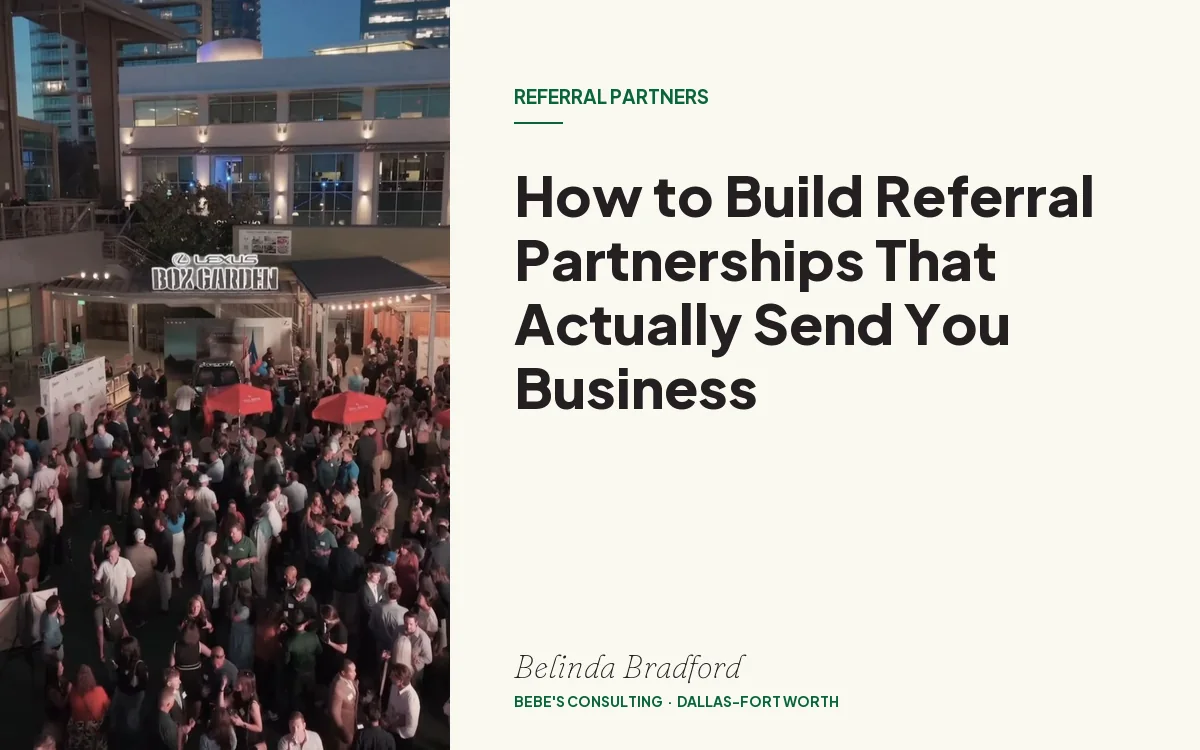
I spend time in most of these. In 2026 that has included DallasMeetup evenings at Legacy Hall, Texas Live! and The Village Dallas, Contractors, Closers & Connections of Dallas, a mixer for nurse founders, charity galas and private industry dinners. I am also a former member of a BNI chapter in Dallas, and I think well of what that structure teaches.
I am not going to rank them, because the ranking would be wrong for you. A contractor, a financial advisor and a nurse starting a company need different rooms. What I can show you is how to judge any of them. How events compare with hiring help is a separate question, covered in business connector versus networking group versus lead generation company.
How do I find out who really attends before I go?
Do ten minutes of checking first:
- Read the attendee list. Events that register through Meetup often show who has signed up.
- Look at photos and posts from past events. Organizers and attendees share them on LinkedIn. You will see the size of the crowd, the setting and often the people.
- Ask someone who has been. "Who did you meet there? Did anything come of it?"
- Ask the organizer. Good organizers like these questions.
Here is a note you can send an organizer, word for word, with your own business in place of mine:
Hi, I'm thinking of coming to your next event and want to make sure it's a good fit. Could you tell me roughly how many people usually attend, what kinds of businesses and roles they are in, and how the evening is structured? Is there time set aside for introductions, or is it open mingling? I own a commercial cleaning company and I'm hoping to meet property managers and office managers. Thank you.
Notice the last line. When an organizer knows who you hope to meet, they can point you to the right people when you arrive. As an organizer myself, I am glad when a guest tells me that in advance.
What does a networking event really cost me?
More than the ticket. Add it up in hours:
- The drive. Crossing the Metroplex at rush hour and back can take longer than the event.
- The event itself.
- The follow-up. Messages, coffees and introductions afterward. This is where the value is, so budget for it. If you have no time to follow up, you do not have time for the event.
- The money. Tickets, membership dues, parking, food and drinks.
- The commitment. A weekly group asks for a set time every week and often for work between meetings. That discipline is the point of it, and it only pays if you keep it.
Multiply your hours per event by the number of events in a month and look at the total. Then ask what else those hours could do. I am not saying the answer is fewer events. I am saying you should know the number. How to compare it with what comes back is in how to measure the return on networking.
How should I work the room once I am there?
- Set a small goal. Three real conversations beat thirty handshakes.
- Arrive early. The room is quieter, people are easier to approach, and the organizer has time to introduce you.
- Ask for their story first. What are you building? How did you get into it? Hearing the answer is one of my favorite parts of any evening.
- Have your two sentences ready: what you do and for whom, and who would make a great connection for you. At our mixer, three attendees do just this in a business card spotlight in front of the room.
- Introduce people to each other. "You two should meet" is the most useful thing you can say at an event, and people remember who said it.
- Write a note on the card or in your phone right after each conversation: what you talked about and what you promised.
- Do not sell. The goal of the evening is a second conversation, not a signed order.
- Look the part. I believe in showing up, dressing to impress and making every first impression count.
What are the signs an event is not worth going back to?
- Everyone is selling and nobody is buying. A room full of people pitching each other the same services.
- The crowd is completely different every time. Relationships need repeat contact. If nobody comes back, ask why.
- No host. Nobody greets you, nobody introduces anyone, and newcomers stand alone.
- You can't hear. A venue too loud for conversation defeats the purpose.
- Closed circles. Regulars who talk only to each other.
- The evening is really a sales presentation for the organizer's product.
- You have gone three times, followed up properly, and nothing has moved. Not one second conversation. That is your answer.
Give a room a fair try before you judge it. You are a stranger the first time, and one visit tells you little. But a fair try includes doing your part. If you did not follow up, you have not tested the event. You have tested not following up.
How do I follow up so the evening pays off?
Within 48 hours, while they still remember your face:
- Send a LinkedIn request with a note that mentions what you talked about.
- Deliver anything you promised. The name, the link, the introduction.
- Invite two or three people to coffee or a call. Not everyone. The ones where you saw a real reason to keep talking. Go in ready, the same way you would prepare for a business introduction.
- Make one introduction for someone else. When we show up for one another and share what we have, good things can happen.
- Log it. Event, who you met, next step.
The people you keep meeting in the same rooms are also where referral partners come from. Once you spot one, the next steps are in how to build referral partnerships.
How many events should I attend, and when should I drop one?
Fewer than you think, more regularly than you think. Trust builds through repeat contact, so being a familiar face in two or three rooms does more for you than being a stranger in ten. A sensible starting mix is one room where your customers are, one where your potential referral partners are, and one you simply enjoy.
Review every 90 days. For each event, write down how many times you went, how many follow-up conversations came out of it, and whether any led to an introduction, a partner or business. Keep the ones that are moving, change how you work the ones that are not, and drop a room that has had a fair try.
If you want a structured room to start with, the DFW Networking & Professional Mixer I help run meets on the first Wednesday of every month from 6 to 8 PM, with registration on Meetup. The evening includes live speed networking rounds and the business card spotlight, and we have had guest features such as a photographer who gave attendees free headshots. Come ready to connect.
And if you would rather have a plan than a full calendar, that is what my networking strategy work is: deciding which rooms fit your goal and what to do in them. You can read more about me or start a conversation.
Key takeaways
- Judge an event by who attends, the format, the cost in hours and what happens afterward.
- Decide your goal first: customers, referral partners, visibility and peers each call for a different room.
- Check the attendee list, past photos and the organizer's answers before you give up an evening.
- Three real conversations and follow-up within 48 hours beat a pocket full of business cards.
- Become a regular in two or three rooms and review each one every 90 days.
Questions owners ask next
Are paid networking groups better than free events?
Not better, different. A paid membership group usually brings commitment: the same people every week, a structure for passing referrals and accountability. Free and low-cost events bring variety and volume, with less structure and less obligation. You can use both: an open event to meet new people and a committed group to deepen a few relationships. Choose by who is in the room and whether you will keep the commitment, not by the price.
What should I bring to a networking event?
Business cards, a pen, a charged phone and a clear answer to two questions: what do you do, and who would be a great connection for you. Bring a goal as well, such as three real conversations. Leave the brochures and the sales pitch at home. If the event gives you a name tag, wear it high on your right side, where it is easy to read during a handshake.
I'm an introvert. How do I handle a room full of strangers?
Pick events with structure, such as speed networking rounds, so the format starts the conversations for you. Arrive early while the room is small. Set a goal of two or three good conversations and give yourself permission to leave once you have had them. Prepare two questions you like asking. Many people in the room are as relieved as you are when someone else speaks first and asks about them.
Should I go to events outside my own industry?
Yes, if your customers or referral partners are there. Events inside your industry are good for learning and for peers, but the room is full of people who sell what you sell. An event built around another trade, where you may be the only one who does what you do, can be a better place to meet buyers and partners. Ask the organizer whether outside professionals are welcome before you go.
Business connector and founder of BeBe's Consulting in Dallas-Fort Worth. About five years in business development, a former BNI Preston Center member, and one of the people behind the monthly DFW Networking & Professional Mixer.
About BelindaThis article is general information, not legal, tax or financial advice. Rules on referral fees differ by profession: check yours before you pay or accept one.