
Choose by what you are missing. A networking group gives you a room full of people and asks for your time. A lead generation company gives you a volume of contacts or booked calls and asks for your money. A business connector gives you a small number of chosen introductions backed by personal trust. If you need many small sales, look at lead generation. If you need a few important relationships, look at a connector. If you have time and want to build your own circle, join a group.
In this article
- What is the difference between the three, side by side?
- What does a networking group give you, and what does it ask of you?
- What does a lead generation company give you?
- What does a business connector give you that the other two do not?
- Which one fits your situation?
- What goes wrong with each option?
- Can you combine them, and how do you test what works?
- Where should you start this week?
- Questions owners ask next
What is the difference between the three, side by side?
All three promise new business. They get there in different ways, and they cost you different things.
| Option | What you get | What it costs you |
|---|---|---|
| Networking group or event | Regular access to a room of business people, and relationships you build yourself | Mostly time: meetings, one-on-ones, follow-up. Often a membership fee or ticket |
| Lead generation company | Contact details or booked calls with people who match a profile, in volume | Mostly money, plus your time to work leads that do not know you |
| Business connector | Personal introductions to chosen decision-makers and referral partners | A fee, plus your time to prepare and follow up well |
The deeper difference is who the other person trusts when you first speak:
- In a group, they trust you a little, because they have seen you show up.
- With a purchased lead, they trust no one yet.
- With an introduction, they trust the person who introduced you, and you borrow some of that.
What does a networking group give you, and what does it ask of you?
Groups come in a few kinds, and each works differently.
- Structured referral groups. BNI is the best known. It is a paid organization whose chapters meet weekly, with one seat per profession in each chapter, so you are the only one in your field at the table. Members are expected to pass referrals to one another. I'm a former member of the BNI Preston Center chapter in Dallas, and I speak well of it. The structure works for people who commit to it.
- Chambers of commerce. Broader membership, a mix of events, and a tie to a city or community. Good for becoming known locally.
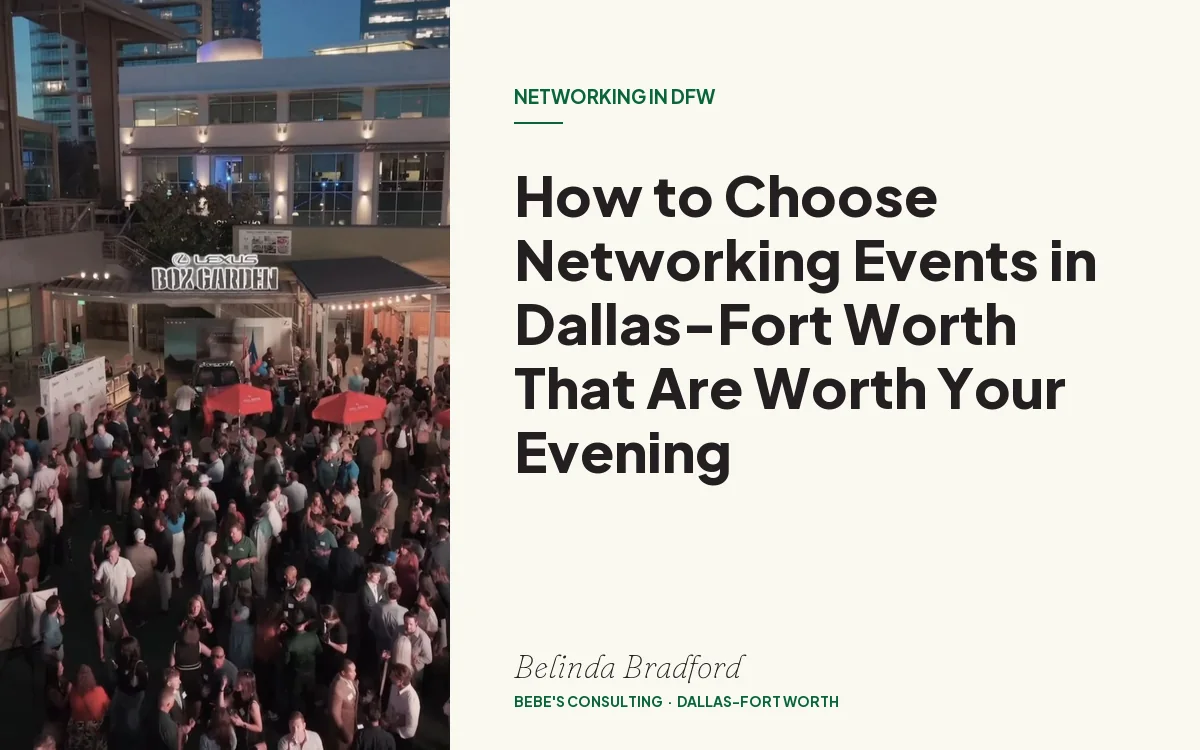
- Open mixers and Meetup events. Low commitment. You register, you show up, you meet whoever is there. The DFW Networking & Professional Mixer I help run is this kind: first Wednesday of every month, 6 to 8 PM, with live speed networking rounds and a business card spotlight where three attendees say what they do and who would be a great connection for them. Details are on the events page.
- Industry gatherings. Rooms built around one trade or one type of buyer.
What a group asks of you is consistency. One visit produces a stack of business cards. Six months of showing up, following up and helping other people produces relationships. If you cannot give it that, a group will disappoint you, and it will not be the group's fault.
For help picking rooms, see how to choose networking events in Dallas-Fort Worth.
What does a lead generation company give you?
Lead generation companies find people who match a profile and get them to raise a hand, or reach out to them for you. The methods vary: online ads and forms, cold email, cold calling, appointment setting. You usually pay per lead, per booked appointment or a monthly fee.
Where it works well:
- Your service is easy to understand and many people need it.
- The buyer decides quickly and often alone.
- You have a sales process that can handle volume: fast call-backs, a script, someone whose job it is.
- A cold start does not hurt you, because the purchase does not depend on deep trust.
Where it struggles:
- The decision-maker is senior and screened by other people.
- The sale depends on reputation: advisory work, large contracts, anything where the buyer asks "who else has used them?"
- Your market is small. If there are only a few hundred possible buyers in the Metroplex, heavy cold outreach can wear out your name before you have a real conversation.
Before you sign with one, ask:
- Is each lead sent only to me, or to other companies too?
- May I read every message that goes out under my name?
- What makes a lead count as qualified, and what happens to the ones that are not?
- Can I start with a short trial before a longer contract?
I compare the two approaches at the level of a single meeting in warm introductions vs. cold outreach.
What does a business connector give you that the other two do not?
Selection and a personal voucher.
A group puts you in a room and leaves the finding to you. A lead generation company finds names and leaves the trust to you. A connector does the finding and lends you trust for the first conversation.
In practice that means:
- Introductions to people chosen for fit, not whoever came that night or whoever filled in a form.
- The other person has agreed to the conversation before you are introduced.
- Access to people who do not attend mixers and do not answer cold email.
- Help building referral partnerships with businesses that serve the same customers you do.
The limits are just as real. A connector cannot give you volume. A connector's reach ends where their relationships end. And an introduction opens a door without closing a sale. For a fuller picture, read what a business connector does.
Which one fits your situation?
Find the line closest to your business.
- You are new, with more time than budget. Start with groups and open events. You will learn how to describe what you do, and you will meet your first referral partners.
- You sell a clear service to many buyers and can handle call volume. Test lead generation, with a small first commitment.
- You sell to a short list of companies, and each account is significant. A connector, or your own targeted relationship building.
- Most of your work already comes by referral and you want more of it. Referral partnerships, built yourself or with a connector's help.
- You are established elsewhere and new to DFW. A connector plus one or two well-chosen rooms. You need local trust faster than a group alone will give it to you.
- You tried a group and "it did not work." Before you switch, ask whether you gave it steady attendance and one-on-one meetings. If you did, the room may be wrong for your buyer. If you did not, the next option will fail for the same reason.
Say you own a commercial cleaning company. Your buyers are office managers and property managers. A chamber gets you known in your city. Lead generation can fill your calendar with small offices. A connector makes sense when you want to meet the people who manage whole portfolios of buildings and never fill in a web form.
What goes wrong with each option?
Networking groups
- Joining too many and attending none of them properly.
- Selling to the room instead of getting to know it.
- A room full of people who all want to sell and nobody who buys what you offer.
- Collecting cards and never following up.
Lead generation companies
- Leads sold to several of your competitors at once.
- Booked calls with people who do not remember agreeing to one.
- Contracts that lock you in before you have seen lead quality.
- Outreach sent in your name that you would be embarrassed to read. Ask to see every message first.
Business connectors
- A network that sounds wide and turns out thin in your field.
- Introductions made without the other person's agreement.
- Promises of revenue or a fixed count of new clients.
- An owner who treats each introduction as a sales call and wears out the connector's goodwill.
Can you combine them, and how do you test what works?
Yes, and most healthy businesses do. They are not rivals. A common mix: one group for steady presence, a few referral partners, and a connector for the people you cannot reach yourself. Lead generation can sit beside that if your service suits volume.
Test before you commit to more:
- Pick one option to start. Adding three things at once means you will not know what worked.
- Write down what success looks like in conversations, not revenue: for example, meetings with the right role, second meetings, proposals requested.
- Give it a full quarter of real effort. Relationships are slow at the start.
- Track where every new conversation came from. A simple spreadsheet is enough. My guide to measuring the return on networking shows what to record.
- Review and adjust. Keep what produced good conversations, change one thing, repeat.
When you visit a group as a guest, ask a member this:
"I'm deciding where to spend my networking time this year. Can I ask you three things? Who do members here mostly sell to? How long were you coming before it started to pay off for you? And who in this room should I meet first, given that I work with [your type of customer]?"
Their answers tell you more than any brochure. And the third question often gets you an introduction on the spot.
Where should you start this week?
Write one sentence: "The person I most need to meet is a [role] at a [type of company] in [area]." Then ask where that person spends time and who they already trust.
- If they go to rooms you can enter, go to those rooms.
- If they respond to ads or search for services like yours, lead generation or your own marketing can reach them.
- If they are reached only through people they know, you need an introduction, from your own contacts or from a connector.
If you are unsure which of the three describes your buyer, that is the question a networking strategy session answers. You can also tell me who you are trying to reach, and I will tell you honestly whether I think a connector is the right tool.
Key takeaways
- A networking group costs mostly time, a lead generation company costs mostly money, and a connector trades on personal trust.
- Lead generation suits simple services with many buyers; a connector suits a short list of high-value relationships.
- Groups reward steady attendance and one-on-one meetings, not a single visit.
- Most businesses combine the options, but test one at a time so you know what worked.
- Start by naming the person you need to meet and asking who they already trust.
Questions owners ask next
Is BNI worth it for a small business?
It can be, if you commit to it. BNI chapters meet weekly and hold one seat per profession, so the structure rewards members who attend every week, meet other members one-on-one and pass referrals themselves. It suits businesses whose customers are other local owners and households. Visit a chapter as a guest, ask members who they mostly sell to, and be honest with yourself about the weekly time.
Can I use a lead generation company and a business connector at the same time?
Yes, as long as they are not reaching the same people. Cold outreach to someone a connector is about to introduce you to can spoil the introduction. Keep a shared list of target companies, mark which ones are being approached through relationships, and exclude those from any cold campaign. Use lead generation for the wide part of your market and introductions for the short list that matters most.
Which option is best for a brand-new business?
Usually groups and open events, because they cost little and teach you a lot. You practice explaining what you do, you learn who your real buyer is, and you meet your first referral partners. Once you can describe your best customer clearly and have a few people who will vouch for your work, a connector or a lead generation test becomes much more useful.
How do I know a networking group is not working for me?
Give it a fair test first: steady attendance, one-on-one meetings with members, and follow-up after every event. If after a few months you have had good conversations but none with people who buy what you sell or who serve your customers, the room is a poor match. If you have had few conversations at all, look at your own effort before you blame the group.

Business connector and founder of BeBe's Consulting in Dallas-Fort Worth. About five years in business development, a former BNI Preston Center member, and one of the people behind the monthly DFW Networking & Professional Mixer.
About BelindaThis article is general information, not legal, tax or financial advice. Rules on referral fees differ by profession: check yours before you pay or accept one.