
A business connector introduces you to specific people you would struggle to reach on your own: decision-makers, potential clients and referral partners. The job is finding the right person, checking that both sides want the conversation, and setting it up so the first meeting has a reason to happen. Hiring one is worth it when you know who you want to meet and can deliver once the door opens. It is not worth it if you want someone to do your selling for you.
In this article
- What does a business connector do, in plain terms?
- How is a connector different from a salesperson, a broker or a coach?
- What does a good introduction look like?
- When is hiring a business connector worth it?
- When is it not worth it, and what should you do instead?
- What goes wrong when owners hire a connector?
- How do you get ready before you hire one?
- So, is hiring a business connector worth it?
- Questions owners ask next
What does a business connector do, in plain terms?
I'm Belinda Bradford. I own BeBe's Consulting in Dallas-Fort Worth, and connecting people is my work, so let me describe the job the way I would over coffee.
A connector stands between two people who should know each other and do not yet. The introduction is the part you see. Most of the work happens before and after it.
- Getting clear on who you need. Not "more clients." A role, a type of company, a situation. "Operations managers at distribution companies that run their own trucks" is a target a connector can act on.
- Finding the person. Through relationships the connector already has, and through the people those relationships can reach.
- Asking first. A careful connector checks with the other person before putting you both in one email. When the introduction arrives, they have already said yes to it.
- Framing the introduction. Who you are, why now, and what is in it for the other side. A few sentences each.
- Following up. Did the meeting happen? Was it a fit? What should the next introduction look like, based on what you learned?
- Building your referral base. Introducing you to people who serve the same customers you do and can send you business for years, not once.
Some connectors also help with the plan around all of this: which rooms to be in, which groups to join or leave, and how to describe what you do so people remember it. That is what I mean by a networking strategy.
How is a connector different from a salesperson, a broker or a coach?
People mix these up, and the mix-up causes most of the disappointment. Here is the difference.
| Role | What they do | What they do not do |
|---|---|---|
| Business connector | Introduces you to chosen people and prepares both sides | Pitch, negotiate or close for you |
| Outsourced salesperson | Sells your service on your behalf | Usually arrive with long-standing relationships of their own |
| Broker or finder | Brings two parties to one transaction and is paid on the deal | Stay for the relationship after the deal |
| Lead generation company | Produces contact details or booked calls in volume | Vouch for you personally |
| Business coach | Helps you plan and stay accountable | Make introductions as the main service |
The line that matters: a connector lends you trust. When someone a decision-maker already knows says "you two should talk," you start the meeting with credibility you did not have to build from zero. A list of names cannot do that. I compare the options in detail in connector vs. networking group vs. lead generation company.
I spent about five years in business development, helping business owners act on their goals. What I learned about myself there is that my greatest strength is building connections and helping people thrive. That is why I do this work and not another kind of consulting.
What does a good introduction look like?
You can judge a connector by one email. A good introduction is short, both people expected it, and each can see why the other is worth an hour. Here is the shape, with made-up names.
Subject: Introduction: Dana (commercial HVAC) and Marcus (property management)
Dana, Marcus, I spoke with each of you this week and you both said you would like to meet.
Marcus, Dana owns a commercial HVAC company in Dallas. Her team handles service contracts for multi-tenant office buildings, which is the kind of property you told me you are adding this year.
Dana, Marcus runs operations for a property management firm with buildings across the Mid-Cities. He is reviewing his service vendors before budget season and wants to compare how different contractors handle after-hours calls.
You both care about fast response for tenants, so I think a conversation is worth it. Dana, will you send Marcus two or three times that work for you? I'll step back from here.
Look at what is in it:
- Both people agreed before the email was sent.
- Each person learns why the other matters to them, not a biography.
- There is a reason to talk now.
- One person has a clear next step, and the connector gets out of the way.
What happens next is up to you. I wrote a full guide on how to prepare for a business introduction so that first meeting leads somewhere.
When is hiring a business connector worth it?
It tends to pay off when most of these are true for you.
- You can name who you want to meet. A role and a type of company, or a kind of referral partner.
- One new client matters a lot. If a single good relationship can change your quarter, a few right conversations beat a hundred random ones.
- You sell on trust. Professional services, business-to-business work, anything with a long decision and a big commitment.
- You deliver well and can show it. Customers who will speak for you, examples of your work, a clear way to describe results.
- You are entering a new room. You moved to DFW, or you want to move from residential to commercial, or from small accounts to larger ones.
- Your time is the bottleneck. You could build these relationships yourself, but not while running the company.
- You will do the follow-up. Quickly and personally.
Picture a commercial roofer who does excellent work but knows mostly homeowners. The people who decide on roofs for warehouses and retail centers are property managers, facility directors and general contractors. He could spend a long time finding his way to them through events alone. A connector who already knows those people can shorten that distance. The roofer still has to win the work on his own merit.
When is it not worth it, and what should you do instead?
I would rather tell you now than have you find out after you have paid someone.
- You sell a low-priced product to many consumers. Advertising and search reach volume. Introductions do not.
- You cannot yet describe your best customer. No connector can aim at a blur. Do that thinking first. It costs nothing.
- You need revenue this month. Introductions start relationships, and relationships move at the other person's speed.
- You have no room for new work. A warm introduction you cannot serve damages two reputations.
- You have not used your own network yet. Start there.
If the last one is you, here is the do-it-yourself version:
- Ask your five best customers who else they know with the same problem you solved for them.
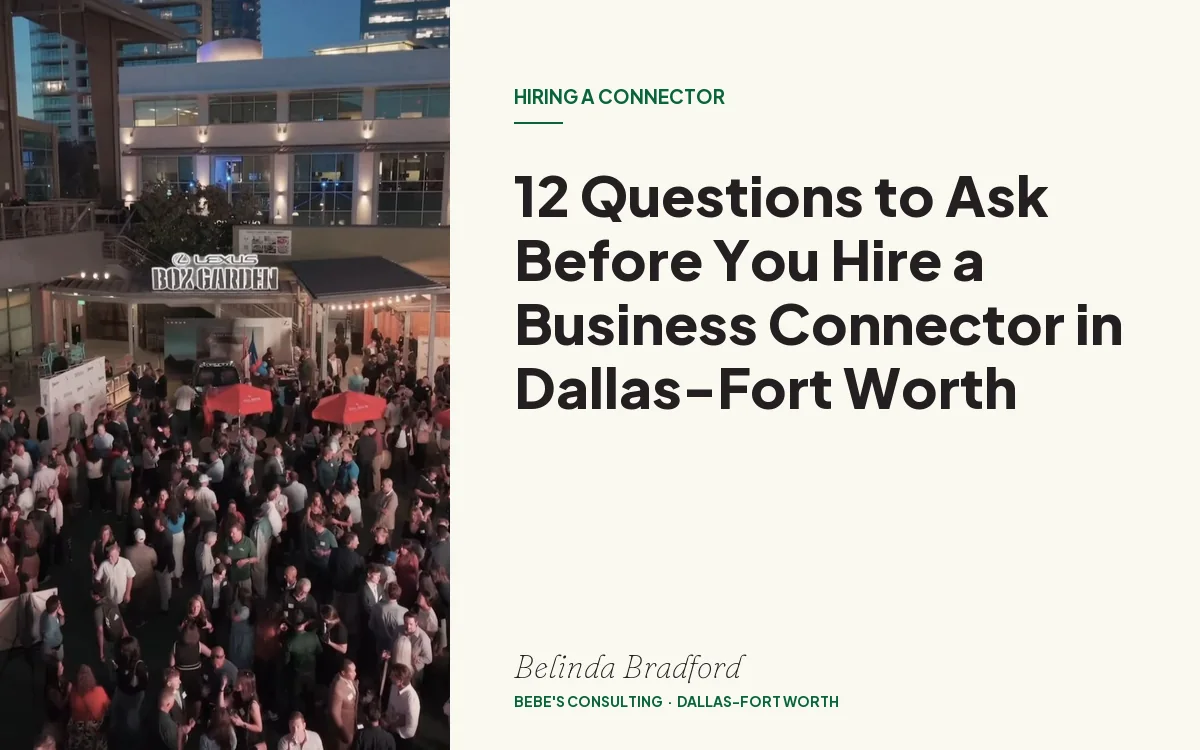
- Pick one room and show up every month so people get to know you. I help run the DFW Networking & Professional Mixer on the first Wednesday of each month, 6 to 8 PM. Details are on the events page.
- Find two businesses that serve your customers before or after you do, and build a real relationship with each. My guide to building referral partnerships walks through it.
Many owners get a long way on those three steps alone.
What goes wrong when owners hire a connector?
Most problems fall into two groups: mistakes the owner makes, and warning signs about the connector.
Mistakes on the owner's side
- Treating an introduction like a lead. Pitching in the first five minutes tells the other person the introduction was a sales setup. It also embarrasses whoever introduced you.
- A vague target. "Anyone who needs insurance" gives a connector nothing to work with.
- Slow follow-up. If you take a week to reply, the warmth is gone and the connector thinks twice about the next one.
- Silence afterward. If you never report back, the connector cannot improve the next introduction.
- Counting instead of judging. Ten introductions to the wrong people are worth less than one to the right person.
Warning signs about the connector
- A promise of revenue, deals or a set number of new clients.
- Name-dropping, but no clear answer on how well they know those people.
- Introductions sent without asking the other person first.
- No interest in what you do well or who you are a bad fit for.
Before you sign with anyone, including me, use these questions to ask before hiring a business connector.
How do you get ready before you hire one?
The more of this you bring to the first conversation, the better your introductions will be.
- Write your target in one sentence. Role, type of company, area, and the situation that makes them need you. Example: "Owners of dental practices in Collin County that are adding a second location."
- Write your "why me" in two sentences. What you do better than the usual option, and proof someone else can check.
- List who you already know. Customers, partners, groups you belong to. A connector should add to this, not repeat it.
- Define a good first meeting. Usually it is not a sale. It is a second conversation, a site visit, or permission to send a proposal.
- Decide who follows up and how fast. My rule of thumb: reply within one business day.
- Decide what you will track. Introductions made, meetings held, second meetings, proposals, new business, and referrals that came later.
If you already have those six, we will have a useful first conversation. You can read how I approach strategic introductions, or start a conversation with me.
So, is hiring a business connector worth it?
My answer: it is worth it when the introduction is the missing piece, and not worth it when something else is.
If your service is strong, your target is clear and the only thing between you and the right people is that they have never heard of you, a connector can help. If the offer is still fuzzy, or you cannot take on more work, fix that first and keep your money.
No connector, me included, can promise you clients. I can open a door and tell both of you why I think you should talk. Earning the business is yours to do.
A simple test before you spend anything: write down the five people who would matter most to your business if they knew you. If you can reach them through people you already know, do that. If you cannot, that gap is what a connector is for.
Key takeaways
- A business connector finds the right person, asks both sides first and frames the introduction; you still earn the business yourself.
- A connector is not a salesperson, a broker or a lead generation company, and the main difference is personal trust.
- Hiring one fits owners who sell on trust, can name who they want to meet and will follow up within a day.
- If you cannot describe your best customer or need revenue this month, do the groundwork first.
- Judge introductions by fit, not by how many you receive.
Questions owners ask next
Is a business connector the same as a networker?
Not quite. A networker builds relationships for their own business. A connector builds and uses relationships on behalf of other people, as a service. The skills overlap: showing up, listening, remembering what people need. The difference is the direction. When you hire a connector, their attention is on who would be a great connection for you, and they put their own reputation behind each introduction.
Do business connectors guarantee new clients?
A trustworthy one does not. A connector controls who you meet and how well the meeting is set up. They do not control your pricing, your proposal, the other company's budget or its timing. Be careful with anyone who promises revenue or a set number of signed deals. A fair commitment sounds like this: a clear description of who they will try to reach, how they will introduce you, and how you will both review progress.
How many introductions should I expect from a connector?
There is no standard number, and a high count is not the goal. One introduction to the person who makes the decision is worth more than many to people who cannot say yes. Ask the connector how they define an introduction, whether the other person agrees to it first, and how you will review fit together. Then judge the work by meetings that were worth having.
Can I be my own business connector?
Yes, and I encourage it. Ask your best customers who else they know, attend one room consistently, and build two or three referral partnerships with businesses that serve the same customers. Introduce other people generously, because people return the favor. A paid connector makes sense when you need to reach people outside your current circle, or when you do not have the hours to build those relationships yourself.

Business connector and founder of BeBe's Consulting in Dallas-Fort Worth. About five years in business development, a former BNI Preston Center member, and one of the people behind the monthly DFW Networking & Professional Mixer.
About BelindaThis article is general information, not legal, tax or financial advice. Rules on referral fees differ by profession: check yours before you pay or accept one.